Why Your Glucose Readings Change in the Last Weeks of Summer
Quick Answer: Glucose readings commonly shift at the end of August without any change in eating. Dehydration concentrates blood glucose, so a hot week can raise readings by a measurable amount purely through fluid loss. Heat changes absorption from injected insulin and changes how quickly a meal empties from the stomach. Nights are lengthening, which shifts sleep timing and therefore the cortisol curve that sets your morning number. And late August is when schedules change - school, work, travel - and meal timing is one of the strongest non-food influences on glucose there is.
Same breakfast, same portion, same time. The number is thirty points higher than it was two weeks ago.
This is one of the most common late-summer questions, and the answer is almost never that something has gone wrong. Several seasonal variables move at once at the end of August, and each of them has a documented effect.
This is general information, not medical advice. Any sustained change in your readings is worth a conversation with the clinician who manages your care.

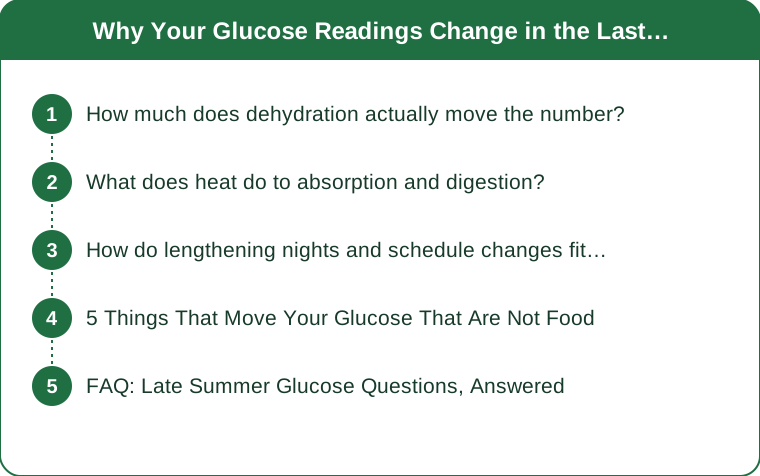
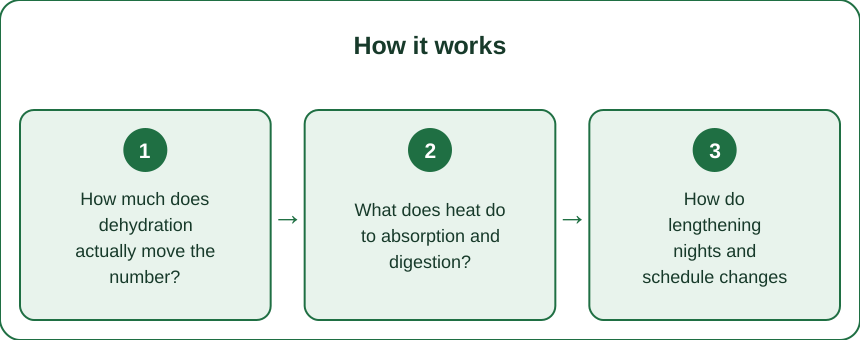
How much does dehydration actually move the number?
Enough to explain a shift that looks alarming.
Blood glucose is a concentration - glucose per volume of blood. Reduce the volume and the concentration rises with no change in the amount of glucose present. A hot late-August week with insufficient fluid intake reduces plasma volume, and the reading goes up.
This is why readings often look worse during a heat wave and settle within a day or two of it breaking, without any intervention at all.
The effect runs the other way too, which matters for interpretation. Rehydrating rapidly can make a reading look better than the underlying situation, so a number taken right after a large drink of water is not directly comparable to one taken after a hot afternoon outdoors.
There is a second-order effect worth knowing. Dehydration reduces kidney glucose clearance, so the kidneys remove less glucose from the blood at exactly the moment concentration is rising. The two effects compound.
The practical version: if your readings jumped during a hot stretch, check your hydration before changing anything else. Dark urine, headache, and thirst that shows up alongside the higher readings is a strong signal that the number is telling you about fluid, not about food.
What does heat do to absorption and digestion?
It speeds up some things and slows down others, and both change the shape of the curve.
Heat increases peripheral blood flow. For anyone using injected insulin, this means faster absorption from the injection site in hot conditions, which can produce a steeper early drop followed by a rise later than expected. This is well established and is a common reason summer dosing patterns do not carry into autumn unchanged - and why the reverse shift happens as the weather cools in late August and September.
Heat also slows gastric emptying in many people, particularly when combined with dehydration. A meal that normally peaks at 45 minutes may peak later and flatter in a heat wave, and then revert to the earlier, sharper peak when the weather cools. Nothing about the meal changed. The timing of the same curve did.
Exercise interacts with this strongly. A workout in high heat raises stress hormone output - adrenaline and cortisol - more than the same workout in mild conditions, and both raise glucose. This is the reason a hot-weather session can end with a higher reading than it started with while the identical session in October lowers it.
As late August cools, all of these revert. If your numbers looked one way in the first week of August and different in the last, the weather is a legitimate suspect before diet is.

How do lengthening nights and schedule changes fit in?
They move your cortisol curve, and cortisol sets your fasting number.
Morning glucose is substantially driven by the pre-waking cortisol rise, which prompts the liver to release stored glucose in preparation for waking. That curve is anchored to your sleep timing, and late August is when sleep timing changes for a large share of people.
By the end of August, sunrise is roughly an hour later than at the solstice in most of the country, and school and work schedules are resuming. Waking earlier relative to daylight, or shifting bedtime by an hour, shifts the cortisol peak and therefore the fasting reading.
Short sleep has a direct and well-replicated effect on insulin sensitivity. Even a few nights of reduced sleep measurably reduces glucose tolerance in healthy people. Late August, with schedule transitions and shorter nights of actual sleep, is a common period for this.
Meal timing is the other big one. Late eating produces a higher glucose response than the identical meal earlier in the day, because insulin sensitivity follows a circadian pattern and is lower in the evening. A summer of 8:30pm dinners moving back to 6:30pm - or the reverse - changes the numbers without changing the food.
Log the timing, not just the content, for two weeks. In late August, timing usually explains more of the variance than anything on the plate.
5 Things That Move Your Glucose That Are Not Food
1. Fluid status. Covered above, and it is the largest single non-food variable in hot weather. Concentration effects can account for a meaningful jump on their own.
2. Sleep debt. A few short nights measurably reduces insulin sensitivity. This is one of the most reliable non-dietary effects in the literature and one of the most commonly ignored.
3. Illness and inflammation, including subclinical. The immune response raises glucose through stress hormones and inflammatory signaling. Readings often rise a day or two before you notice you are getting sick - a pattern many people with continuous monitors learn to recognize.
4. Stress and anticipation. Adrenaline releases stored glucose. A stressful morning meeting raises glucose without a calorie involved, and late August brings the return of a lot of scheduling stress.
5. The monitor site and the site age. For continuous monitors, readings drift as a sensor ages and vary by placement, compression and temperature. A high reading in the last day of a sensor’s life, or one you have been lying on, deserves a fingerstick confirmation before it deserves a change in behavior.
The common thread: before adjusting food or medication in response to a pattern, rule out the variables that are not food. In late August there are more of them active at once than in any other month.
FAQ: Late Summer Glucose Questions, Answered
Should I change my routine because of a hot week?
Not on your own, and not on a few days of data. Hydrate properly, keep logging, and see whether the pattern persists once the weather settles. If it does persist beyond a week or two, that is the point to bring the data to your clinician rather than adjusting independently.
Why is my morning number the one that moved most?
Because the fasting number is the one most tied to sleep timing and the cortisol curve, and late August changes both. It is also the reading least buffered by recent food, so hormonal and sleep effects show up in it most clearly.
Does the same meal really produce different numbers day to day?
Yes, substantially - and this is normal. Research using continuous monitoring has repeatedly shown large day-to-day variation in the response to identical meals within the same person, driven by sleep, prior activity, stress, hydration and time of day. One reading is a data point. A two-week pattern is information.
TL;DR:
- Dehydration concentrates blood glucose and reduces kidney clearance - a hot week raises readings on its own.
- Heat speeds insulin absorption and slows gastric emptying, changing the shape of the curve rather than the food.
- Lengthening nights and schedule changes shift the cortisol curve, which is what sets your fasting number.
- Short sleep measurably reduces insulin sensitivity within a few nights.
- Rule out the non-food variables - fluid, sleep, stress, illness, sensor age - before changing anything.
- Two weeks of pattern beats any single reading, and it is the thing worth bringing to your clinician.
This is general information, not medical advice. Late August moves several dials at once - the useful response is to log carefully and let the pattern, not the day, tell you something.
Keep Reading
This article is for general informational purposes only and is not medical advice. Always consult a qualified health professional for guidance specific to you.