Why the Same Meal Hits Your Blood Sugar Differently in Cooler Weather
Quick Answer: Several things shift together as the weather cools: daily incidental activity drops, appetite rises, food choices move toward warmer and more carbohydrate-dense meals, daylight exposure falls, and sleep timing shifts. Each of these independently affects glucose response, so the same meal can produce a noticeably different curve in October than it did in July — usually a higher one.
You eat the same breakfast you have eaten all summer. Your afternoon energy crashes in a way it has not for months.
The breakfast did not change. Four things around it did.

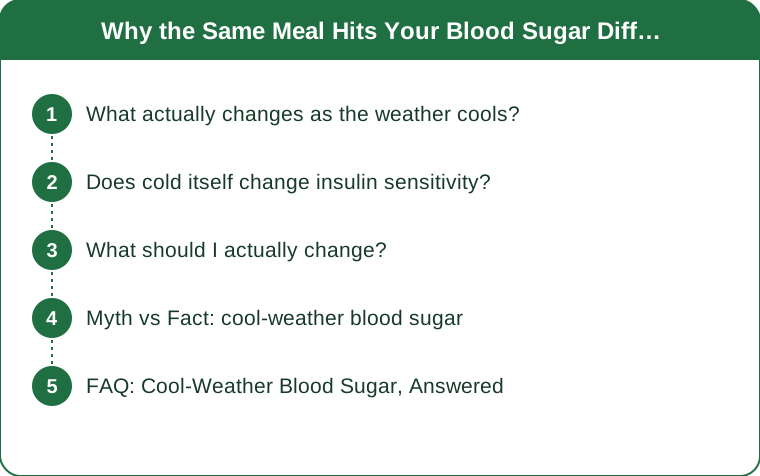
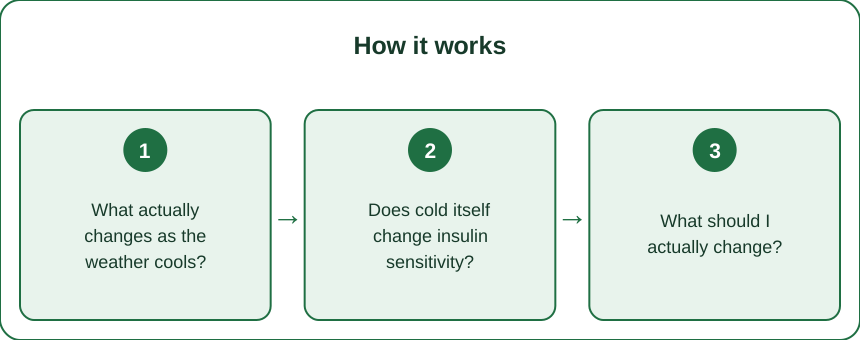
What actually changes as the weather cools?
Five factors, and they compound rather than offsetting each other.
1. Incidental activity drops sharply. Muscle contraction moves glucose into cells through a pathway that does not require insulin, which is why movement lowers blood sugar so reliably. Autumn quietly removes thousands of steps a day — shorter walks, less time outdoors, more driving. Less muscle activity means less non-insulin glucose uptake all day long.
2. Appetite increases. Cooler weather raises appetite, and the increase is disproportionately for calorie-dense and carbohydrate-heavy foods. This is a genuine physiological pattern, not just a comfort-eating habit.
3. Food choices shift. Summer eating skews toward salads, fruit, and lighter meals. Autumn eating skews toward bread, pasta, roasted starches, and baked goods. The same portion of a different food produces a very different glucose response.
4. Daylight exposure falls. Light exposure governs circadian rhythm, and circadian timing affects insulin sensitivity — the same meal typically produces a larger glucose rise in the evening than in the morning. Less morning light and earlier darkness shift that timing.
5. Sleep changes. Both the amount and the timing shift in autumn, and even a single night of short sleep measurably reduces insulin sensitivity the following day.
The compounding: less activity plus more carbohydrate plus poorer sleep plus circadian disruption is four factors pushing the same direction. No single one is large; together they are noticeable.
Does cold itself change insulin sensitivity?
The research here is more interesting than most people expect, and it points in a direction that surprises people.
Cold exposure activates brown adipose tissue, which burns glucose to generate heat. Studies of repeated cold exposure have found improvements in insulin sensitivity and glucose uptake — meaning genuine cold exposure may be metabolically beneficial rather than harmful.
But that is not what most people experience in autumn. Going from a heated house to a heated car to a heated office is not cold exposure. What most people actually experience is reduced activity in warm indoor environments, which is the opposite.
Shivering also matters and rarely happens. Shivering thermogenesis uses muscle glucose substantially, but it requires genuine cold, not mild coolness.
The honest summary: the direct thermal effect of autumn on glucose is small for most people and probably slightly favorable. The behavioral changes are much larger and unfavorable, and they dominate what you actually see.
What this means practically: do not look for a temperature explanation for a worse glucose pattern in autumn. Look at your step count, your sleep, and what you have started eating. Those three will explain nearly all of it, and all three are addressable.

What should I actually change?
In order of how much difference they make.
1. Protect the post-meal walk above everything else. A 10 to 15 minute walk after eating is one of the most effective and best-supported interventions for blunting a post-meal glucose rise. It works because active muscle takes up glucose without needing insulin, and the effect is largest in the 30 to 60 minutes after a meal when glucose is peaking.
This is exactly the habit that disappears in autumn, and it is the single highest-value thing to protect. Indoors counts. Around the office counts. Ten minutes counts.
2. Keep the meal structure, change the ingredients. Autumn food is not a problem in itself. A roasted vegetable and protein meal is excellent; a bowl of pasta alone is not. Keep protein, fat, and fiber alongside the carbohydrate — eating vegetables and protein before the starch in the same meal produces a measurably lower glucose rise than eating them in the reverse order.
3. Get morning light. Ten to fifteen minutes of outdoor light early in the day supports circadian alignment, which supports both insulin sensitivity and sleep quality. In autumn this requires deliberate effort because you are commuting in dimmer conditions.
4. Protect sleep timing more than sleep duration. Consistency of timing is more achievable than adding hours and has real effects on next-day glucose handling.
5. Add resistance training if it is not already there. Muscle is where most glucose gets stored. More muscle means more storage capacity, and this is one of the strongest long-term levers available. Autumn is the natural season to add it.
Myth vs Fact: cool-weather blood sugar
Myth: Warm comfort foods are inherently bad for blood sugar. Fact: temperature has nothing to do with it. Soup with beans, lentils, and vegetables is excellent. A warm meal built on refined starch is not. The problem is composition, not warmth.
Myth: You need more carbohydrate to stay warm in cold weather. Fact: thermoregulation does increase energy needs slightly in genuine cold, but for anyone spending most of their day in heated buildings the increase is minimal. The increased appetite exceeds the increased need.
Myth: Blood sugar naturally runs higher in winter and there is nothing to do. Fact: seasonal patterns in glucose markers do appear in population data, but they largely track behavior — activity, diet, and sleep. They are not a fixed seasonal fate.
Myth: A hot drink spikes blood sugar the same as a cold one. Fact: temperature does not change the glucose response, but what goes in the drink does. The autumn spiced latte is a genuine glucose event — often 30 to 50g of sugar — and it is usually the actual change behind an autumn afternoon crash.
Myth: Exercising in the cold burns more glucose so it does not matter what you eat. Fact: cold exercise does use somewhat more energy, but the difference is small relative to meal composition. You cannot out-exercise a meal structure problem, in any season.
FAQ: Cool-Weather Blood Sugar, Answered
Should I eat differently in the morning versus the evening in autumn?
If anything, front-load. Insulin sensitivity is generally higher earlier in the day, so a larger breakfast and lighter dinner suits most people — and this matters more in autumn when evenings start earlier.
Is an indoor walk as good as an outdoor one for post-meal glucose?
For glucose specifically, yes — the mechanism is muscle contraction and it does not care where you are. Outdoor walking adds light exposure and mood benefits, which are separate goods.
Why do I crash harder in the afternoon once the weather turns?
Usually a combination of a more carbohydrate-heavy lunch, no post-meal walk, and less light exposure. Fixing the walk alone resolves it for many people.
Do I need a CGM to figure this out?
No. For most people without diabetes, tracking energy after meals and paying attention to the post-meal walk gets you most of the benefit. If you have diabetes or suspect a glucose problem, this is a conversation for your doctor — this is general information, not medical advice.
TL;DR: Five things changed together and they all push the same direction.
- Incidental activity dropped, and muscle contraction moves glucose without needing insulin. This is the biggest factor.
- Appetite rises and food choices shift toward carbohydrate-dense meals. Same portion, different response.
- Less daylight and shifted sleep both reduce insulin sensitivity independently.
- Cold itself is probably slightly favorable — the behavioral changes are what actually matter.
- Protect the post-meal walk above everything else. Ten to fifteen minutes, indoors counts.
- Eat vegetables and protein before the starch in the same meal. Measurably lower rise, zero effort.
If your afternoon energy has changed this month, put a ten-minute walk after lunch back in before you change anything you eat.
Keep Reading
This article is for general informational purposes only and is not medical advice. Always consult a qualified health professional for guidance specific to you.