Is a Continuous Glucose Monitor Actually Worth It If You're Not Diabetic?
Quick Answer: For most metabolically healthy non-diabetics, a CGM’s main value is educational rather than medically necessary — it can reveal which specific foods and habits cause bigger personal blood sugar swings, which some people find useful for fine-tuning diet choices, but the data requires informed interpretation, since some perfectly normal glucose responses can be misread as concerning without proper context.
A CGM for a non-diabetic isn’t harmful to try, but it’s a curiosity and optimization tool more than a necessary health intervention.

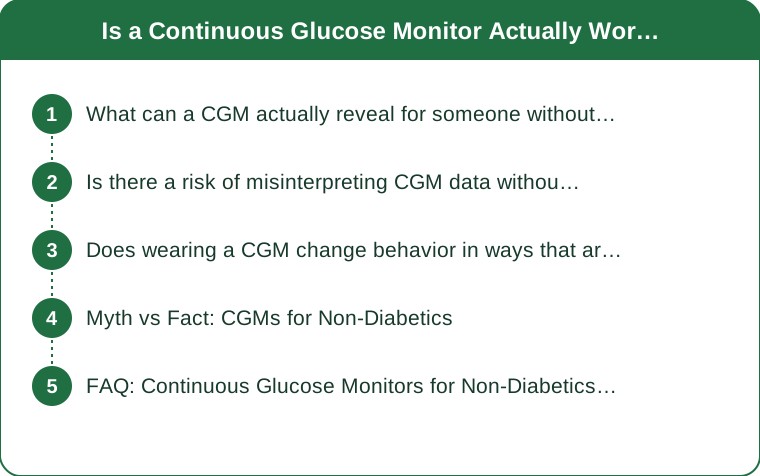
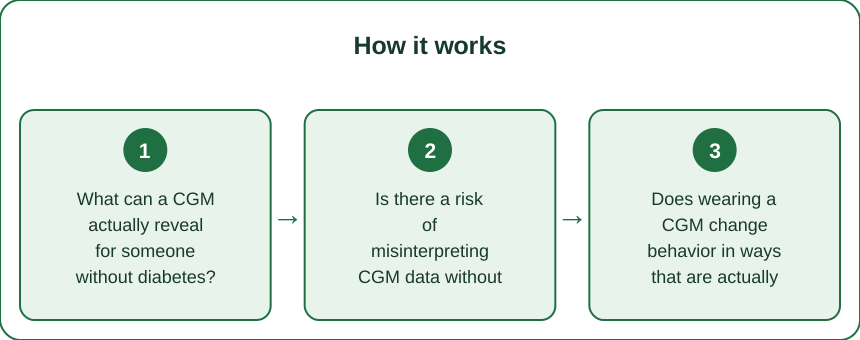
What can a CGM actually reveal for someone without diabetes?
It can show individual-specific glucose responses to particular foods, meal combinations, exercise timing, sleep quality, and stress, which do genuinely vary somewhat between people even among those with normal overall glucose regulation — this personalized data is the main draw for non-diabetics interested in optimizing energy levels or diet composition.
Is there a risk of misinterpreting CGM data without diabetes-specific training?
Yes, this is one of the more commonly raised concerns among clinicians — normal, healthy glucose fluctuation in response to meals can look alarming to someone unfamiliar with typical glucose curve shapes, leading to unnecessary anxiety or overly restrictive eating changes based on a normal physiological response rather than an actual problem.

Does wearing a CGM change behavior in ways that are actually beneficial?
For some people, yes — real-time feedback can reinforce already-healthy choices (like taking a walk after a carb-heavy meal) more effectively than general dietary advice does, simply because the personal, immediate data feels more motivating than abstract guidelines. This behavioral reinforcement effect is arguably the most substantiated benefit for otherwise healthy users.
Myth vs Fact: CGMs for Non-Diabetics
Myth: a CGM can diagnose prediabetes or diabetes on its own. Fact: CGM data can prompt someone to seek proper diagnostic testing, but it isn’t itself a diagnostic tool — actual diagnosis still requires standard clinical testing (like an A1C or fasting glucose test) interpreted by a doctor. Myth: any glucose spike shown on a CGM is inherently bad. Fact: some glucose rise after eating is completely normal physiology, and the shape and speed of return to baseline matters more than the fact that a rise occurred at all.
FAQ: Continuous Glucose Monitors for Non-Diabetics Questions, Answered
How much does a CGM typically cost for non-medical, wellness use?
Costs vary by provider and whether it’s obtained through a wellness-focused subscription service versus a medical prescription route, generally running from moderate to fairly expensive on an ongoing monthly basis, since it isn’t usually covered by insurance for non-diabetic use.
Is a doctor’s involvement recommended even for non-medical CGM use?
Discussing it with a doctor first is a reasonable step, particularly to get proper context for interpreting the data and to rule out any actual underlying concern the monitor’s readings might reveal. This is general information, not medical advice.
Are there any downsides to wearing a CGM beyond cost?
The main non-cost downside is the risk of over-focusing on or misinterpreting normal fluctuations, which can create unnecessary food anxiety in people prone to that — for some, the awareness is genuinely useful, but it isn’t a universally positive experience.
TL;DR:
- For non-diabetics, a CGM’s value is mainly educational and personalization-focused, not medically necessary
- Normal glucose fluctuation after meals can be misread as concerning without proper context
- Real-time feedback can reinforce already-healthy habits more effectively than general advice
- A CGM can’t diagnose prediabetes or diabetes on its own — that still requires standard clinical testing
This is general information, not medical advice — a CGM is a reasonable optimization tool for the curious, not a required health device for the metabolically healthy.
Keep Reading
This article is for general informational purposes only and is not medical advice. Always consult a qualified health professional for guidance specific to you.