Why Your Blood Sugar Goes Up After Hard Exercise
Quick Answer: High-intensity exercise triggers adrenaline and cortisol, which tell the liver to release stored glucose to fuel the effort. During short, hard sessions the liver often releases more than the muscles immediately take up, so blood glucose rises rather than falls. It typically returns to baseline within one to two hours, and the same person doing easy steady work would see glucose drop instead.
This surprises almost everyone who wears a continuous glucose monitor for the first time, because the expectation is that exercise always lowers blood sugar.

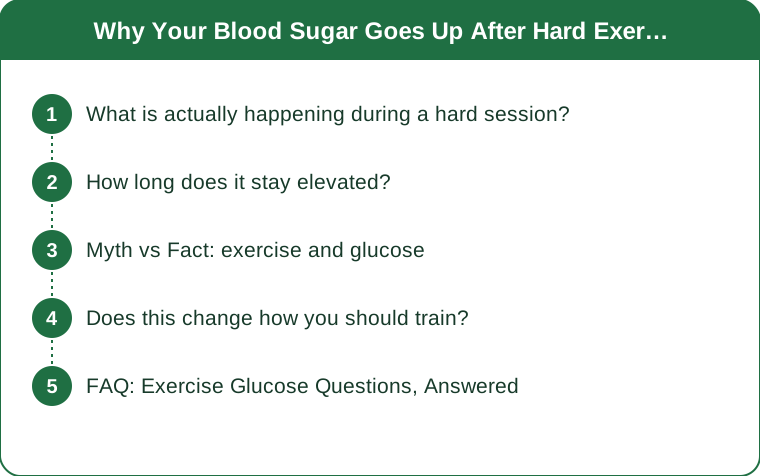
What is actually happening during a hard session?
A hormonal instruction that outruns the demand.
When intensity climbs above roughly your lactate threshold, your body activates the sympathetic nervous system. Adrenaline and noradrenaline rise sharply, and they carry a specific message to the liver: release glucose now.
The liver complies through glycogenolysis, breaking down stored glycogen and dumping glucose into the bloodstream. Simultaneously, adrenaline suppresses insulin secretion from the pancreas — sensible, because insulin would drive glucose into storage at the exact moment you need it circulating.
The result: a large glucose release, reduced insulin, and muscle uptake that — during short, very hard efforts — does not keep pace. Net effect: blood glucose rises. Readings climbing well into the elevated range during a hard interval session are commonly reported and not in themselves a sign of a problem.
Why easy exercise does the opposite: at lower intensity, adrenaline stays modest, the liver’s release is proportionate, and working muscles take up glucose through a pathway that does not require insulin at all. Uptake matches or exceeds release, so glucose falls.
How long does it stay elevated?
Usually one to two hours, following a fairly consistent shape.
During the session: a rise, often starting within the first 10 to 15 minutes of hard work and continuing as intensity accumulates.
Immediately after: frequently the peak. Adrenaline stays elevated for a while after you stop, and the liver does not switch off the moment your watch does.
30 to 90 minutes after: the decline. Adrenaline clears, insulin sensitivity is now enhanced, and muscles begin restocking glycogen. Glucose usually drops back toward baseline and sometimes slightly below it.
The following 24 to 48 hours: improved insulin sensitivity. This is the actual metabolic payoff of the session, and it is why judging exercise by the during-session number misses the point entirely.
When to look more closely: if levels stay elevated for more than about three hours post-session, or if the pattern is new and accompanied by unusual thirst, fatigue or other symptoms, that is worth raising with a clinician rather than filing under normal.

Myth vs Fact: exercise and glucose
Myth: Exercise always lowers blood sugar.
Fact: Intensity determines the direction. Easy to moderate aerobic work lowers it. High-intensity intervals, heavy resistance training and competitive efforts frequently raise it acutely. Both are normal.
Myth: A post-workout spike means you should not do intense exercise.
Fact: The acute rise and the chronic benefit are separate things. High-intensity training is well established as improving insulin sensitivity over time. Judging it by a two-hour window is like judging a strength program by how weak you feel after the session.
Myth: A spike means you ate wrong before the workout.
Fact: This happens fasted too. It is hormonal, not dietary. Pre-workout food changes the magnitude somewhat but not the mechanism.
Myth: If your monitor shows this, you are becoming insulin resistant.
Fact: An adrenaline-driven rise during exertion is a normal stress response present in metabolically healthy people. The measure that matters is your fasting baseline and your response to food, not your response to intervals.
Myth: You should take insulin or eat to correct it.
Fact: For anyone not on glucose-lowering medication, no action is needed — it resolves on its own. For people who do use insulin, this pattern is genuinely tricky and needs an individual plan built with a clinician, because correcting an exercise-driven rise can cause a low an hour later.
Does this change how you should train?
Only in how you interpret the data, for most people.
Do not stop doing intervals because of the number. The acute rise is not damage. If the goal is metabolic health, high-intensity work remains one of the more effective tools available.
Do reconsider the timing if you monitor fasting glucose. A hard evening session can leave glucose modestly elevated into the night for some people, which then shows up on a morning fasting reading. If your morning numbers look off, check whether they follow hard evening sessions specifically.
Do add easy work if the goal is acute glucose management. A 10 to 15 minute walk after meals is one of the better-supported interventions for post-meal glucose, and it works through the non-insulin-dependent uptake pathway. That is a different tool for a different job than intervals.
Do consider a cool-down. Five to ten minutes of easy movement after hard work speeds adrenaline clearance and often shortens the elevated window.
Do stop reading the monitor mid-workout. Real-time glucose during exercise generates anxiety and almost never changes a good decision. Look at the trend afterward.
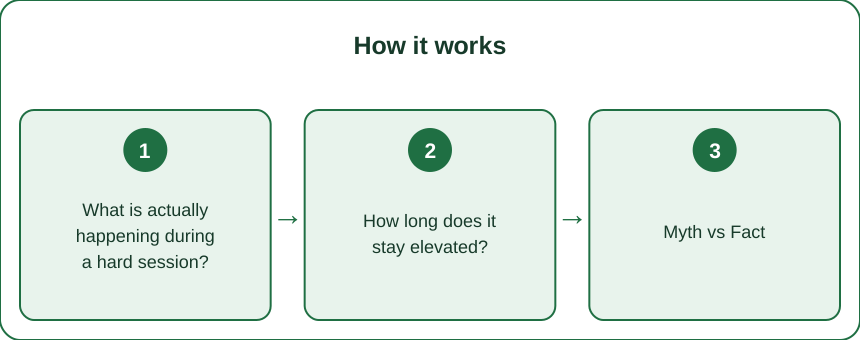
FAQ: Exercise Glucose Questions, Answered
Why does resistance training spike me more than running?
Heavy resistance work is highly sympathetic — short maximal efforts with rest between, which is an efficient recipe for adrenaline release without the sustained muscle uptake of continuous aerobic work. Lifting commonly produces bigger rises than a steady run.
Does caffeine before training make it worse?
It can. Caffeine raises adrenaline independently and can blunt insulin sensitivity acutely, so a strong pre-workout plus intervals stacks two things pushing the same direction. If the size of the rise bothers you, that is the easiest variable to test.
Is a CGM even useful if it does this?
Yes, but for the right questions — meal responses, sleep, stress, alcohol and daily patterns. It is a poor tool for judging workouts, because the acute exercise signal is dominated by hormones rather than by anything you can act on.
TL;DR:
- Hard exercise raises adrenaline, which tells the liver to release glucose faster than muscles take it up.
- The rise typically peaks just after the session and resolves within one to two hours.
- Easy aerobic work does the opposite because uptake keeps pace with release.
- The real benefit — improved insulin sensitivity — shows up over the following 24 to 48 hours.
- If you use glucose-lowering medication, this pattern needs an individual plan with your clinician.
The number during intervals is a stress response, not a verdict. Judge training by the days after, not the hour during. This is general information, not medical advice.
Keep Reading
This article is for general informational purposes only and is not medical advice. Always consult a qualified health professional for guidance specific to you.