Why One Bad Night of Sleep Raises Your Glucose the Next Day
Quick Answer: A single night of restricted sleep reduces insulin sensitivity measurably - studies have found reductions in the range of 20 to 25% after one night of about four hours. Cortisol rises, growth hormone patterns shift, and the same meal produces a higher glucose response the next day. It is temporary and reverses with normal sleep, but it explains why a familiar breakfast can produce an unfamiliar number.
If you wear a monitor, this is one of the first genuinely surprising things you notice: the strongest single predictor of tomorrow’s readings is often not what you eat, but how you slept.

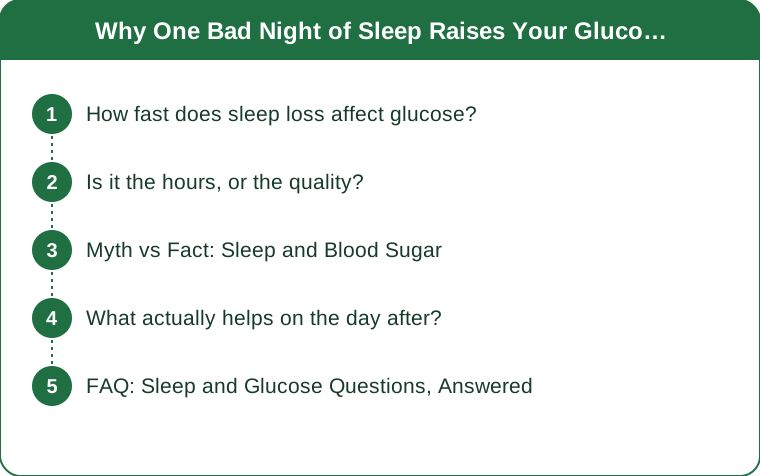
How fast does sleep loss affect glucose?
Within one night, and the effect size is larger than most people expect.
Controlled studies restricting sleep to around four hours have found reductions in insulin sensitivity in the range of 20 to 25% the following day, measured in healthy young adults with no metabolic condition. This is not a long-term effect - it appears immediately.
Fasting glucose rises modestly, and post-meal glucose rises more. The clearest signal is usually in the response to breakfast: the same meal produces a higher peak and a slower return to baseline.
Cortisol is a major mechanism. Sleep restriction raises evening cortisol, and cortisol opposes insulin - it promotes glucose release from the liver and reduces uptake in tissue.
Sympathetic nervous system activity increases. Short sleep shifts the balance toward the stress response, which independently raises circulating glucose.
And appetite hormones shift too. Ghrelin rises and leptin falls with short sleep, which raises hunger and specifically increases preference for high-carbohydrate foods - meaning the day after poor sleep tends to involve both worse handling of carbohydrate and more of it.
Is it the hours, or the quality?
Both, and they act through partly different routes.
Duration matters most below about six hours. The metabolic effects appear reliably when sleep drops under six hours and become substantial under five.
Fragmentation matters even at normal duration. Sleep broken into pieces produces measurable metabolic effects even when the total time asleep is adequate. Eight hours with six awakenings is not equivalent to eight uninterrupted hours.
Deep sleep specifically affects glucose regulation. Studies that selectively suppress slow-wave sleep without changing total duration still find reduced insulin sensitivity, which points to deep sleep as a particularly important component.
Timing plays a role independent of both. Sleeping at hours misaligned with your circadian rhythm - shift work being the extreme case - produces glucose effects beyond what the duration alone would predict.
Untreated sleep apnea is the case worth flagging. It fragments sleep and causes repeated oxygen desaturation, and it has a well-established association with insulin resistance. If someone snores heavily and wakes unrefreshed despite adequate hours, that is worth investigating rather than optimizing around.

Myth vs Fact: Sleep and Blood Sugar
Myth: One bad night does not matter metabolically. Fact: It measurably does, though it is fully reversible. The concern is not the single night - it is a pattern of single nights that never quite resolves.
Myth: You can fix it with caffeine and get on with the day. Fact: Caffeine improves alertness and does nothing for insulin sensitivity. In some people it acutely raises glucose slightly, particularly on an empty stomach after poor sleep.
Myth: Catching up at the weekend resets it. Fact: Recovery sleep does restore much of the effect, and it is genuinely worth doing. But large weekday-to-weekend swings create their own circadian misalignment, which is associated with worse metabolic markers independently.
Myth: A high reading after bad sleep means something is wrong with you. Fact: This response occurs in metabolically healthy people. It is a normal physiological reaction to sleep loss, not evidence of a condition.
Myth: Eating less the next day compensates. Fact: It reduces the input but does not restore insulin sensitivity. Movement does more than restriction here - a walk after meals is more effective than skipping them.
What actually helps on the day after?
Three things with real effect sizes, and one that matters more than the rest.
Walk after meals. Ten to fifteen minutes of walking after eating lowers post-meal glucose meaningfully, and the effect is larger on days when insulin sensitivity is reduced. This is the single highest-value action available on a bad-sleep day.
Front-load protein and fiber at breakfast. The first meal after poor sleep tends to produce the largest excursion. A breakfast weighted toward protein and fiber rather than fast carbohydrate blunts it substantially.
Get morning daylight. Ten to twenty minutes of outdoor light shortly after waking supports circadian alignment and improves the following night’s sleep, which is what actually resolves the problem.
Do not compound it with a late night. The strong temptation after a bad night is to push through and stay up. Two consecutive short nights produce more than twice the effect of one.
Be careful about interpreting readings. If you track glucose, note sleep alongside it. Otherwise you will attribute a high reading to a food that was not responsible, and end up eliminating something harmless while the actual cause repeats every week.
And protect the next night rather than the day. Cool, dark, ventilated room, consistent wake time, and no alcohol - alcohol fragments sleep architecture even when it shortens time to fall asleep.
FAQ: Sleep and Glucose Questions, Answered
How much sleep do I need to avoid this?
Most adults need seven to nine hours, and the metabolic effects appear consistently below six. Consistency of timing appears to matter alongside total duration.
Does napping help?
A short nap can partially offset the alertness cost and there is some evidence it helps metabolic markers after sleep restriction. Keep it under 30 minutes and before mid-afternoon so it does not affect that night.
Will my readings return to normal?
In people without diabetes, yes - typically after one or two nights of normal sleep. Persistently elevated readings that do not resolve with sleep recovery are worth discussing with a doctor.
Does this mean poor sleep causes diabetes?
Chronic short sleep is associated with increased risk of type 2 diabetes in population studies, and the acute mechanism described here is a plausible part of why. A single bad night is not a risk factor; a decade of five-hour nights is a different question.
This is general information, not medical advice. Anyone managing diabetes or with concerns about glucose readings should discuss changes with their healthcare team.
TL;DR:
- One night of restricted sleep can cut insulin sensitivity by roughly 20 to 25% the following day.
- Cortisol, sympathetic activity, and appetite hormones all shift - you handle carbohydrate worse and want more of it.
- Fragmented sleep matters even at normal duration, and suppressed deep sleep alone produces the effect.
- On the day after: walk after meals, front-load protein and fiber, get morning light, and protect the next night.
The practical value of knowing this is mostly interpretive. If you track glucose at all, sleep belongs in the log next to food - otherwise you will spend months blaming oats for something a short night caused. And on the days you know were bad, a fifteen-minute walk after breakfast does more than any dietary adjustment you could make.
Keep Reading
This article is for general informational purposes only and is not medical advice. Always consult a qualified health professional for guidance specific to you.