Why the Exact Same Meal Spikes Your Blood Sugar Differently From One Day to the Next
Quick Answer: Sleep quality the night before, stress level, recent physical activity, and even meal order within the day all independently shift how the same meal affects blood sugar — glucose response isn’t a fixed property of a food, it’s an interaction between that food and your body’s current state, which is why continuous glucose monitor users regularly see real variation from an identical meal.
It’s easy to assume a food has one fixed glucose impact, but research on individual glucose variability consistently shows the same meal can produce meaningfully different responses in the same person depending on same-day and prior-day factors.

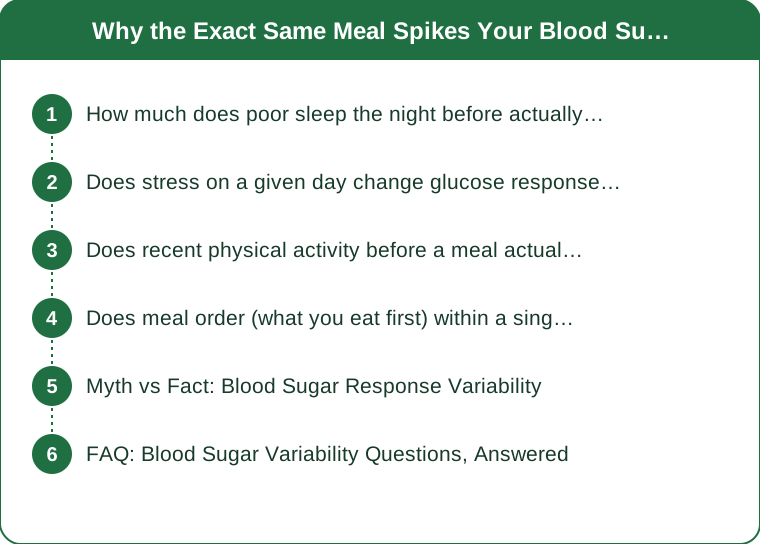
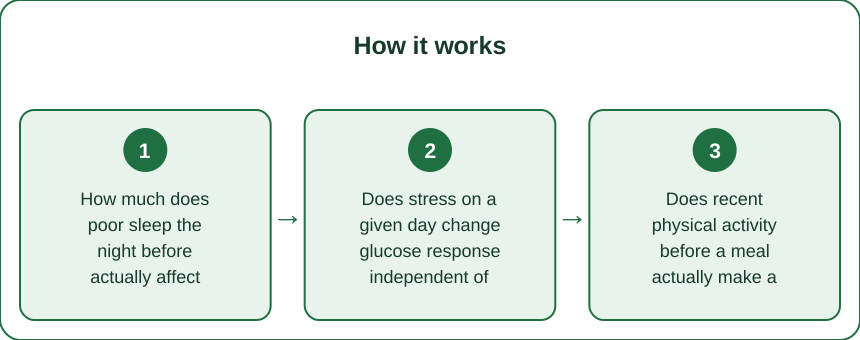
How much does poor sleep the night before actually affect blood sugar response?
Meaningfully — research on sleep and glucose regulation has found that even a single night of shortened or poor-quality sleep can measurably reduce insulin sensitivity the following day, meaning the same meal that produced a modest glucose response after good sleep can produce a noticeably larger spike after a poor night’s sleep.
Does stress on a given day change glucose response independent of what you eat?
Yes — elevated cortisol from acute stress raises blood sugar directly through its effect on glucose release from the liver, and this effect stacks on top of whatever glucose response a meal itself would produce, meaning a stressful day can genuinely amplify a meal’s glucose impact beyond what the food alone would predict.
Does recent physical activity before a meal actually make a measurable difference?
Yes, and fairly reliably — physical activity in the hours before a meal improves insulin sensitivity temporarily, meaning the same meal eaten after a walk or workout often produces a smaller glucose spike than the identical meal eaten after a sedentary period, an effect well-documented enough that some glucose-monitoring guidance specifically recommends a short walk before larger meals.

Does meal order (what you eat first) within a single meal actually matter?
Yes — several studies have found that eating vegetables and protein before carbohydrates within the same meal measurably blunts the glucose spike compared to eating the same foods in the reverse order or all together, which means even the sequence of eating identical foods on a plate can shift the resulting glucose curve.
Myth vs Fact: Blood Sugar Response Variability
Myth: A food has one fixed glycemic impact that applies every time. Fact: the same food’s actual measured glucose response varies meaningfully by individual and by day, based on sleep, stress, and activity, not just the food’s inherent properties.
Myth: Glucose spikes are only about carbohydrate content. Fact: carbohydrate content is a major factor, but sleep debt, stress, and pre-meal activity all independently shift the response for the same carbohydrate amount.
Myth: If a meal spiked blood sugar once, it will always do the same thing. Fact: the same meal under different same-day conditions (better sleep, less stress, prior activity) can produce a meaningfully smaller response.
FAQ: Blood Sugar Variability Questions, Answered
Is this day-to-day variability something continuous glucose monitors specifically revealed?
Yes, largely — widespread continuous glucose monitor use in research and consumer settings has made this individual and day-to-day variability much more visible than older single-point blood sugar testing methods could show.
Does this mean tracking blood sugar after just one instance of a meal is unreliable?
A single measurement gives limited information — tracking the same meal across several different days and conditions gives a much more complete and useful picture of typical response range.
Should people with diabetes be especially aware of this day-to-day variability?
Yes — this is general information, not medical advice, but awareness of these factors can be a useful complement to individualized guidance from a healthcare provider managing diabetes or blood sugar concerns specifically.
TL;DR:
- Sleep quality the night before measurably affects next-day insulin sensitivity and glucose response
- Acute stress raises blood sugar directly, stacking on top of a meal’s own glucose impact
- Physical activity before a meal reliably improves insulin sensitivity and blunts the spike
- Eating protein and vegetables before carbs in the same meal changes the resulting glucose curve
This is general information, not medical advice — anyone managing diabetes should rely on individualized guidance from a healthcare provider.
Keep Reading
This article is for general informational purposes only and is not medical advice. Always consult a qualified health professional for guidance specific to you.